

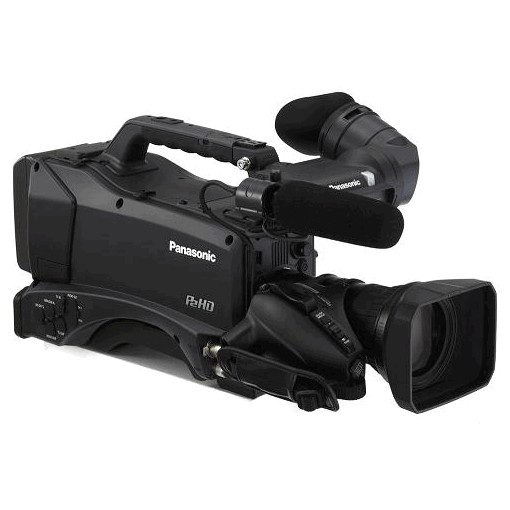

With a new, advanced 1/3 2.2-megapixel 3-chip imager featuring Ultra Luminance Technology (U.L.T.), the HPX370 delivers exceptional video performance for master-quality HD production. The shoulder-mount camcorder offers 10-bit, 4:2:2, full 1920 x 1080-resolution AVC-Intra recording with impressive levels of sensitivity and an interchangeable lens. The AVC-Intra codec is unrivaled for its full-raster, 10-bit, 4:2:2 sampling with none of the inherent compromises of 8-bit, long GOP and 4:2:0 recording. The HPX370 provides the ultra reliability of a solid-state design and the faster speed of a file-based workflow.
The HPX370 utilizes a 20-bit digital signal processor and high-resolution 3-MOS imagers, enhanced with U.L.T., which boosts the sensors performance to rival the image quality and sensitive of ½ imagers. The new U.L.T. sensor results in marked improvements in sensitivity, measured at F10. These high levels of sensitivity and image quality have been achieved with a new high-sensitivity photodiode and low-noise pixel transistor, both based on low-noise analog process technology. The same levels of sensitivity and image production that characterize the interlace mode are now possible in the progressive mode courtesy of Progressive Advanced Processing (P.A.P.), a 3D adaptive processing technology.
With the flexibility of an interchangeable lens, the HPX370 can be used with 1/3 to 2/3 lens adapters for use with existing 2/3 zoom and prime lenses. The camera offers a broad range of creative features including variable frame rates, advanced gamma functions including a new Cine film-like gamma, Chromatic Aberration Compensation (CAC), built-in scan reverse, Dynamic Range Stretch (DRS) function, waveform and vector scope display and focus assist tools. The HPX370 also comes equipped with flash band detection and compensation software built-in for improved CMOS performance.
In contrast with the CCD image sensor, which accumulates still images of single frames that are exposed with identical timing, the MOS image sensor uses a rolling shutter system that sequentially scans each line of pixels. This lowers power consumption and enables high-speed drive, but because the exposure timing differs for each line, when an external flash is used, it tends to produce images where the brightness is divided between the top and bottom of the image. This is called the flash band effect. The AG-HPX370 series is equipped with highly accurate flash band detection and compensation software on the camera’s signal processing LSI. By generating pairs of frames containing flash bands, and frames in which a flash extends from the previous frame to the entire screen, and then using the compensation process to adjust the level, the flash band effect of MOS-based imagers is eliminated.
Also known as
Image sensor size : 1/3 inches
1080p support : Yes
4Κ support : No
Image sensor type : CMOS
HDMI,DVI Output : No
Recording media : P2
Balanced Audio Input (XLR) : 2 Inputs
HD-SDI Output : 1 Output
AVC (H264) recording : Yes
RAW recording : No
Shoulder camcorder : Yes
Lens mount : Bayonet mount
Optical Zoom : 17x
Minimum Illumination : 0.4 Lux
Weight : 5 kg with supplied Fujinon lens
Balanced Audio output (XLR) : No
Monitor size : 3.2 inches
3D Video Support : No
SD-SDI Output : 1 Output

Kandao Obsidian R
4K4K/60fps, 8K8K/30fps 6 fisheye camera, f/2.8 (185) including KanDao Stitching software
Starting price
4.570,00€
Send message

Thank you for your interest.
We will contact you as soon as possible
We will contact you as soon as possible
Send message
We have received your request.
We will contact you as soon as possible
We will contact you as soon as possible
Send message
Thank you for your interest.
We will contact you as soon as possible
We will contact you as soon as possible
Εμπορία, Μελέτη, Εγκατάσταση Συστημάτων Υψηλής Τεχνολογίας
Λ. Ιωνίας 36, Άλιμος, 17456
Τηλ. 210-99.59.659
Email : sales@spectratech.gr
FOLLOW US


Copyright © 2026 SPECTRAtech S.A. . All Rights Reserved.